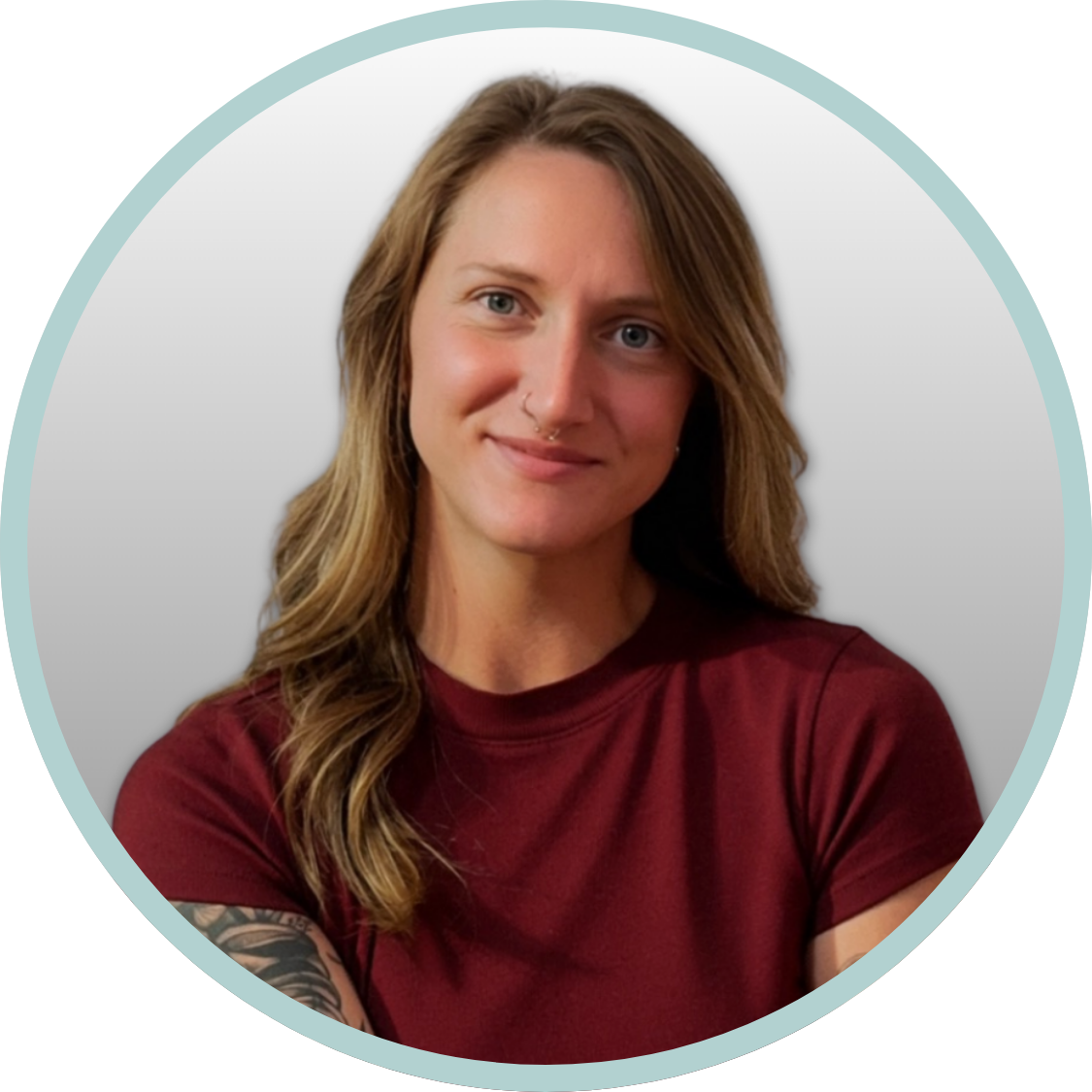
Devon McClain
MSW, LSW | Therapist
she / her
I love people. All people. I don't believe in hate, and I've never found it useful for anything. Everyone carries a story that shaped who they are, and being trusted with that story, getting to walk through it with someone, is what gives this work its meaning for me.
What draws me to this work is the privilege of helping people see themselves clearly, often more clearly than they've ever let themselves before. I take that seriously every time someone sits across from me.
Therapy, for me, is a space where you get to be fully human. Where the parts of you that you've hidden, doubted, or talked yourself out of are allowed in the room, no performance required.
Respect guides everything I do, in this work and in life. I want every client to feel like their full self is welcome here, including the parts they're still working through. I also try to show up authentically, because I think people can feel the difference when someone isn't. And I lean into a strengths-focused approach, because most people are carrying qualities they've never been told they have. I notice them. I name them. I help you start seeing them too.
I'm drawn to Open Space because it doesn't just talk about disrupting harmful systems, it actually lives it. That commitment shows up in how this practice treats people, and it matches something important to me. I believe clients who want a therapist who's willing to name injustice honestly, rather than look past it, will find a good fit here.
If we work together, here's what you can expect: I'll meet you in conversation more often than I'll leave you sitting in silence waiting to land somewhere on your own. This is collaborative, and it unfolds over time, not in a single session. I'll meet you where you are, and I'll gently challenge you when growth calls for it, because what I want most is what's genuinely good for you.
You don't have to have it figured out before you walk in. You just have to show up, and we'll take it from there together.
LANGUAGES SPOKEN
English
THERAPY APPROACHES
Interpersonal
Cognitive Behavioral Therapy (CBT)
Gottman Method
Culturally Sensitive
Strength-Based
IN THE THERAPY ROOM
Empowering
Intuitive
Exploratory
Culturally-Responsive
Adaptive
YOU CAN FIND ME
Front row at a rock concert, walking barefoot in the grass, searching for 70s home decor, watering my plants, trying new restaurants, bouldering, making lavender matcha lattes, and traveling the world!
I’M ALL ABOUT
Genuine relationships, skipping the small talk, finding humor in the hard stuff, sex positivity, and speaking out against injustice.
Clinician Details
-
Aetna
Anthem
BCBS PPO Plans
Capital Blue Cross
Geisinger
Highmark
Independence Blue Cross (IBX)
Optum / United Healthcare
In progress:
UPMC
-
$115 (53-minute session)
-
East End
Telehealth
-
Individual Therapy
-
Adolescents / Teens (14-18)
Adults (18+)
Specialties
-
Romantic relationships are unlike any other bond we form. They ask more of us, expose more of us, and when they struggle, it can feel like everything is at stake.
What I've come to believe, both personally and professionally, is that most relationship struggles aren't about love. They're about communication that broke down, patterns that never got named, and needs that never felt safe enough to say out loud. People don't usually seek out this work because they stopped caring. They come because they care deeply and don't know how to reach each other anymore.
Whether you're coming in with your partner or on your own, this space is for you. Some people want to work on a relationship in real time, navigating conflict, rebuilding trust, or learning how to actually be heard. Others come individually to understand their own patterns, what they keep repeating, what they keep tolerating, and what they actually want from love. Both are valid entry points. Both lead somewhere meaningful.
I bring training and experience in the Gottman Method, an approach rooted in decades of research on how relationships actually work. We'll look at the cycles you're stuck in, the ways you're trying to connect that might be landing as conflict, and the strengths already present that deserve more room.
This work is collaborative, honest, and paced with intention. You don't have to have the right words when you walk in. You just have to be willing to show up, and we'll figure out the rest together.
-
Anxiety has a way of making you feel like you're the only one who experiences the world this way. Like everyone else is moving through life just fine while you're managing something invisible and exhausting, often alone.
I understand that from the inside, not just the clinical literature. Living with panic disorder has shaped how I show up in this work. It's given me a different kind of knowing, one that sits alongside my training rather than apart from it. When you describe what it feels like when it hits, I'm not translating. I already know the language.
What I've found, both personally and professionally, is that anxiety doesn't respond well to force. Pushing through, white-knuckling it, telling yourself to just calm down. None of that works for long. What does work is learning to understand what your anxiety is actually doing and why, and building a relationship with it that isn't just about survival.
In our work together, we'll use cognitive-behavioral strategies to identify the thought patterns that keep anxiety running in the background, and practical tools to interrupt the cycle when panic takes over. We'll move at a pace that feels manageable, because this work asks something real of you and that deserves to be honored. You don't have to have it under control before you come in. Showing up is the first step, and it's enough.
-
Here's something I believe down to my bones: you are a whole person. Not a project. Not a work in progress that only counts once you've fixed enough of yourself. A whole person, right now, exactly as you are.
And yet, so many people walk through life genuinely unsure of that. Putting everyone else's needs first, not because they want to, but because somewhere along the way they learned that their needs were less important. Shrinking, apologizing, second-guessing, performing a version of themselves that feels safer than the real one.
That's what this work is about. Not just building confidence as a concept, but tracing the roots of where self-doubt actually came from. Because your inner critic didn't appear out of nowhere. It has a history, and understanding that history is part of changing its hold on you.
I'm not interested in quick fixes or surface-level reframes. I want to understand the why with you, where these patterns started, what they were protecting you from, and what it would look like to stop needing that protection.
Our work together will be collaborative, honest, and at times, a lot. I bring a lot of myself into this space, and I want to hear everything. I'll work through it with you, using tools drawn from CBT, DBT, Gestalt, and person-centered approaches, among others, so that what we build together actually becomes part of how you move through the world, not just something you remember from a session. You deserve to take up space. Let's start there.